


Colleen MacDonald on the Get Stoked Girls Podcast
- Dec 10, 2025
- 8 min read
A conversation about purpose, global adventure, FKTs, and elevating women in the outdoors.

Meet Colleen MacDonald — ultrarunner, adventurer, and gender equity advocate.
We met Colleen at Whitewater State Park in Minnesota, her home state. From her Midwest roots and childhood dreams of being a female Indiana Jones, to trail running, the Peace Corps, and ultimately setting a record on Kilimanjaro for the Cairn Project, Colleen shares her journey of pushing limits, following her intuition, and using adventure to make an impact. We dive into the logistics of her 62-mile Kilimanjaro FKT, the highs and lows of the climb, and the powerful mission behind supporting women through the Cairn Project.
Keep up with Colleen's work here:
Website: https://colleenmacdonaldathlete.com/
Instagram: https://www.instagram.com/m_cmacdonald/
Listen to this episode of Get Stoked Girls and get notified of new releases by subscribing on Spotify, Apple, YouTube or wherever you get your podcasts!
Running Then and Now
Rhi: What was your childhood like? Were you always the adventurous, outdoorsy kid, or did that come later?
Colleen: I’ve been adventurous for as long as I can remember. My hero as a kid was Indiana Jones, and I wanted to be the female version of him, living a big, wild, globe-trotting life. I spent most of my childhood outside, usually covered in mud and needing to be reminded to change before going anywhere. Even then, I knew I wanted a life full of adventure, and that dream never really left.
Rhi: Now that you live in Colorado, how do you see outdoor recreation in the Midwest when you come back? What is your relationship with it after experiencing the Rockies?
Colleen: Running in the Midwest is very different from Colorado, but I still love it. I started at Afton, Elm Creek, and eventually the Superior Hiking Trail, which really shaped me as an ultrarunner. That trail is rugged, rocky, beautiful, and unlike anything else. It is still the place I think of when I think about my roots.
Minnesota definitely flies under the radar. People in Colorado always assume it is flat, but there is so much great trail running here. And the community is incredible. There is a real sense of ownership and stewardship of the trails. Because I spent so many years running here, it still feels like family.
Rhi: Let’s talk about how you got into trail running. Your first race was in 2015. What was that like and what drew you to ultrarunning?
Colleen: I ran through middle school and part of high school, then focused on swimming through University. I didn’t start running seriously until after graduation, and my first marathon was the Twin Cities Marathon, which is a beautiful race. After a few marathons, I wanted a bigger challenge and decided to try trail running.
I had just returned to Minnesota after living abroad for seven and a half years and was struggling with reverse culture shock. I needed something to push me and scratch that adventurous itch I had since I was a kid. I joined the Mill City Run Club, ran my first 50k, then another on the Superior Hiking Trail, which solidified my love for ultras. I signed up for a 50-mile race and ended up winning it, which showed me that focus and determination could take me further than I expected.
I don’t think I’m naturally gifted at a lot of sports, but I can outwork people.
Rhi: How has running evolved for you? What does it mean to you now compared to when you ran your first road marathon?
Colleen: When I first started running road marathons and ultras, I needed a challenge. I wanted to feel adventurous even living in Minnesota, and running gave me that. As I did more ultras, it became about discovering what I was capable of and testing my limits.
Now running is different. I know what I can do. My endurance, skills, and mental grit are solid. These ultras and adventures are about using that confidence to see what else is possible and to bring more meaning to what I do. It is about pushing further, exploring new challenges, and adding depth to the experience, which is very different from when I first started and everything felt unknown.

Finding Purpose Abroad
Rhi: Let’s pivot to the Peace Corps. You spent three years there. Beyond seeking adventure, what motivated you to join?
Colleen: I would be lying if I said it was all altruistic. There are points in my life when I know I need a change and I have this gut feeling to push myself. After graduating, many of my friends were getting married, going to grad school, or buying houses, and I didn’t want that.
Joining the Peace Corps felt like the right way to do that while also getting out of Minnesota and breaking out of a sense of stagnation. I needed to grow and challenge myself in a way I couldn’t have at home. It was about doing something meaningful and pushing my own limits at the same time.
I move through the world with one intention: leave it better than I found it and make a net-positive mark.
Rhi: Your time in the Peace Corps shaped a lot of your why, especially seeing how women are treated. What were your key takeaways from that experience?
Colleen: I was working with youth, mostly ages 10 to 18, and it was clear how different their opportunities were compared to kids in the U.S. Living in Azerbaijan also made me see the inequalities and disadvantages women face in the United States. Experiencing another culture gave me a lens to understand my own.
In the village I lived in, women were not allowed to run, ride bikes, or be in public alone, even for simple things like walking or reading outside. That made me realize how many experiences and skills, like leadership, resilience, and problem-solving, women were missing out on. Seeing this was enlightening and shaped my thinking about advocacy and the importance of access for women in the outdoors. While things have changed since my time there and opportunities for women in outdoor sports are growing, those early observations had a lasting impact on how I approach this work.
Kilimanjaro with Meaning
Rhi: Let’s start with the Cairn Project. Can you explain what it is, how you found it, and why you wanted your Kilimanjaro FKT to support that mission?
Colleen: I discovered the Cairn Project one sleepless night while searching for organizations supporting women in the outdoors. It’s connected to the Summit Scholarship Foundation and the idea is to encourage women to take on adventures and turn those into fundraising projects. The money raised goes directly to the foundation, helping other women and girls do expeditions on peaks like Mount Baker, Cotopaxi, and Kilimanjaro.
The Cairn Project is also a storytelling collective. Both the women doing the adventures and the scholarship recipients share their journeys, what the outdoors means to them, and what they’ve learned. It gives visibility to women in outdoor spaces while directly funding opportunities for others who might not otherwise have access.
It’s about creating real impact and empowering women to take their first steps into the outdoors.
Rhi: Had Kilimanjaro always been on your bucket list, or how did it become the adventure you chose for your Cairn Project fundraiser?
Colleen: Kilimanjaro had been on my mind since I was a kid. I remember a story my mom read to us about kids stranded on the mountain during a storm, and I thought it was the coolest thing ever. The idea stayed with me, and by 2019 or 2020, I was looking for a big, exciting challenge to break out of a stagnant phase in my life.
I started researching Kilimanjaro and found that only one woman had set an FKT there at the time. It was intimidating but thrilling, and I knew I wanted to do it. I took a scouting trip in 2023 to plan logistics and gain confidence, but I also wanted the climb to have meaning. That’s when I connected it to the Cairn Project, ensuring it wasn’t just about me but could also make an impact for other women in the outdoors.



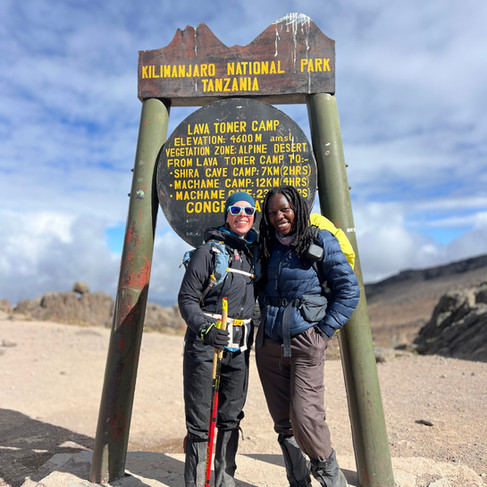
Rhi: What is Kilimanjaro and what route did you choose?
Colleen: Kilimanjaro is the highest free-standing mountain in Africa at 19,341 feet, located in Tanzania. It’s generally considered non-technical, so most routes don’t require mountaineering skills. There are seven main ascent routes and two descent routes.
For our project, we wanted to make it harder than the usual up-and-down FKTs. We chose the northern route, which starts at the Lemosho Gate, crosses the Shira Plateau, goes around the northern edge, and normally descends the standard route. Instead, we descended to Barafu Camp, turned west, retraced much of the route, and returned across the plateau to the trailhead. The planned route was about 53 miles but ended up 62, with the summit coming at mile 27. Most of the route stayed above 12,000 feet. It was long, high, and challenging, and I think we crafted the hardest route we could.

Rhi: You did this with your partner, Brian. Since the Cairn Project is a female-centered mission tied to your advocacy for women in the outdoors, what did it mean to have a male teammate on this project?
Colleen: Having Brian on the project was really meaningful. The project was always female-led, and I was leading it, but Brian amplified our message by reaching people I couldn’t reach and encouraging others to think about supporting women in the outdoors. His support also showed that male allies can help create equitable leadership without diminishing female leadership. From the start, I made it clear I was leading the project, and he was fully on board, which made the experience even more impactful.


Rhi: Let’s dive into the trip itself. What did the adventure look like, when did you do it, how long did it take, and what were a few highs and lows?
Colleen: We were in Africa for about three and a half weeks this past August. The first five days were a recon of the full 62-mile route, which is usually done in nine days. This was to map the route on GPS, acclimate to altitude, and drop gear and food at key points. We worked with guides, which was required for permits, and they were invaluable for route knowledge and logistics. The recon involved hiking 10 to 23 miles a day, managing nutrition, and getting a feel for the summit so we’d be confident for the FKT.
After two days of rest, we started the FKTs at 9 PM to cross the Shira Plateau in the dark and summit in the warmer daytime. The route ended up being 62 miles, all above 12,000 feet, with the summit around mile 27. The FKT took 36 hours and five minutes, including a 30-minute nap. Everything went smoothly — no major issues except I got a bit of altitude sickness at 15,000 feet during the ascent from Barafu camp, but we just pushed through and descended safely. Overall, it went really well, and the planning paid off.
Rhi: Now that you’ve had some time to reflect, what did this experience teach you about yourself?
Colleen: What this project has taught me will continue to evolve, and that’s okay. Big experiences shape us in ways that change over time. Right now, what stands out is that I’ve learned I can trust my gut and intuition. From childhood dreams of adventure to the Peace Corps, ultrarunning, and this FKT, honoring that pull has led to meaningful experiences. It has reinforced that I can trust myself, that following what calls me works out, and that I want a life full of adventure and advocacy.


Get Stoked Girls
Rhi: What advice do you have to get girls stoked?
Colleen: The world is amazing and full of adventures. Whatever dream you have, no matter how big or scary, go for it. Seek out mentors, connect with people who inspire you, and just try. You might discover something you didn’t even know you loved.


